As a playground equipment supplier, we understand that today’s hotel family spaces are no longer just “a slide + a bunch of balls.” Hotel owners want more than just a place for children to “kill time”; they want an “experience engine” that can tell stories, create photo opportunities, extend guest stays, and drive repeat business.
However, limited space, limited budget, and the need to balance child safety with parent comfort… how can these practical problems be solved? Based on the latest global hotel children’s playroom design trends for 2025-2026, the following outlines a set of practical “space utilization strategies.”
I. Vertical Dimension “Mountain Creation”: Turning Flat Play into Three-Dimensional Adventures
The problem with traditional playrooms is their “spreading out”—equipment is laid out flat, taking up a huge amount of space. The latest space utilization approach is to “utilize space vertically.”
The “Mountain Journey” family-friendly room at the Shenzhen Women and Children’s Building provides a textbook example: within a 130-square-meter room, the designer created a layered, receding “mountain.” This “mountain,” with a height base of 35 centimeters, not only accommodates essential functional areas like a living room, dining room, and bedroom, but also cleverly incorporates various play elements such as climbing walls, slides, tunnels, and quiet spaces.
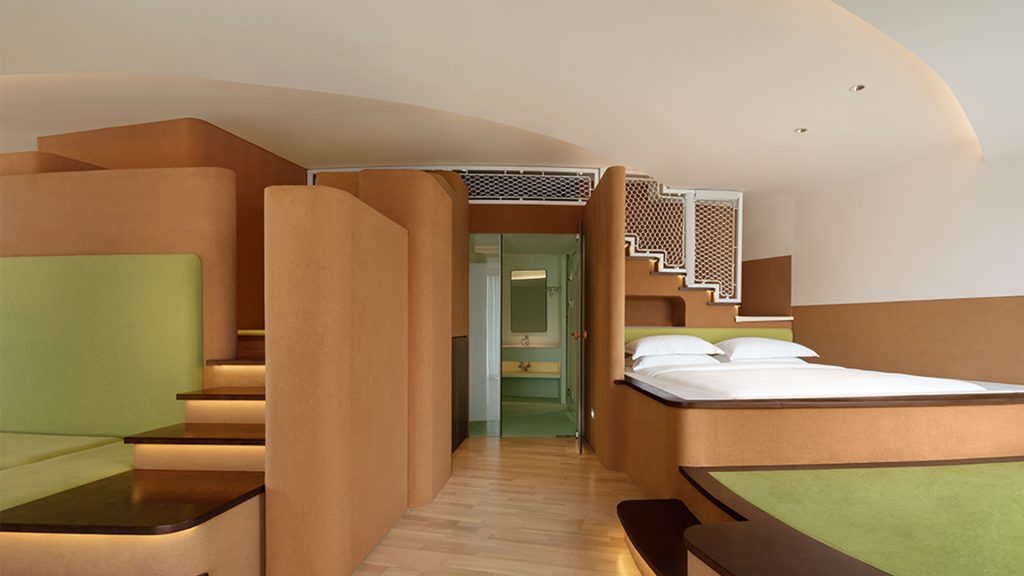
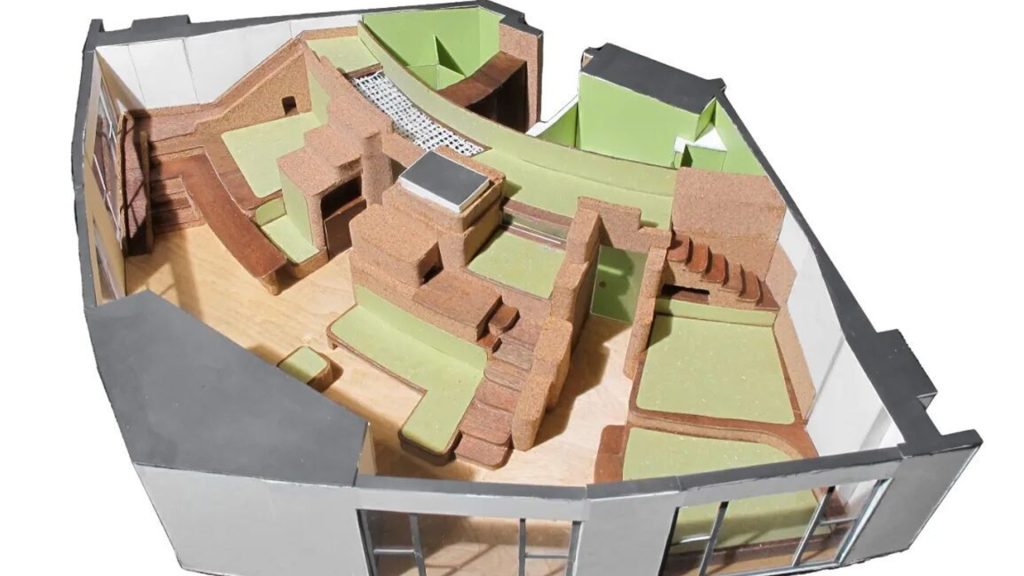
Inspiration for hotel children’s playroom design: “Integrated play furniture,” for example, combining slides with storage cabinets, integrating climbing nets with bed structures, and designing cave reading corners under the stairs. This approach of “structure as function, structure as play” greatly improves space efficiency.
II. From “Large and Comprehensive” to “Deep and Refined”: Simplifying and Focusing on Narrative
Many hotels mistakenly believe that children’s playgrounds must be as large as possible. However, the consensus is that family spaces have entered a stage of stratification, scenario-based design, and IP-driven development; the focus is no longer on size, but on the depth of the experience.
For example, the newly unveiled “Gnomey Hollows” children’s space at PARKROYAL Marina Bay Sands Singapore. While not enormous, it weaves together an original IP, “Gnomey,” into a narrative-driven forest wonderland. The space features an interactive plush fruit and vegetable picking area, a mushroom house, a leaf-cocoon-shaped swing, and even a reading corner. The core of space utilization isn’t about cramming in equipment, but about making every corner a “play area.”
Implications for building family rooms: Help owners plan “micro-themes.” Compared to expensive large-scale IP licensing, customized furnishings, props, and interactive play equipment is more cost-effective. “Theme Park” options, such as “Forest Exploration,” “Naval Adventure,” and “Space Journey,” can be chosen, unifying slides, climbing structures, role-playing equipment, etc., under a single storyline. MooTon case Warm Bear-Themed Family Room at a Hot Spring Hotel is a good example for this.
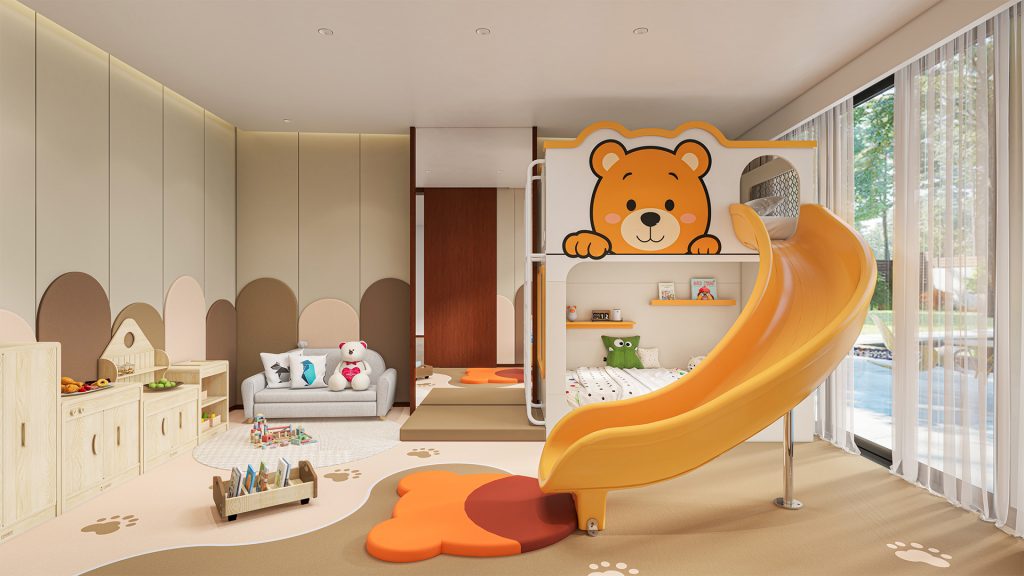
III. Breaking Down “Children’s Barriers”: Creating Inclusive Spaces for All Ages
Recent research shows that parents’ needs for family spaces have transcended “playful decorations,” and they crave immersive experiences that foster interaction, companionship, and emotional connection. This means that children’s playrooms shouldn’t be places where “kids are thrown in to play,” but rather places where “parents are willing to sit down and play with them.”
For example, a comfortable parent rest area can be set up next to the play area, providing phone charging ports and coffee tables. When designing the flow of movement, ensure unobstructed views. Use low partitions or glass fences so that parents can easily see their children from the rest area. At the same time, increase the selection of “parent-child co-play” equipment (such as double swings and parent-child seesaws) to allow adults to participate.
IV. Space “Transformation”: Time-Sharing Reuse and Flexible Modularization
For hotels with limited space, time-sharing reuse is key to breaking the deadlock. Can an area that is a children’s playground during the day be used as a multi-functional hall or restaurant at night? Shiton Hotels has launched a “time-sharing parent-child system”: a children’s play area during the day, and a low-cost solution at night through foldable furniture, modular design, and mixed reality (MR) projection technology. By installing projectors and motion sensors on walls or floors, ordinary corners can be transformed into interactive beaches, virtual fishing ponds, or magical art studios, without the need for wearable equipment.
Implications for Suppliers: Utilize interactive projection systems as a supplement or highlight to traditional amusement equipment. The hardware costs of such equipment are relatively controllable, and the content library can be updated to maintain freshness, making it particularly suitable as a “check-in point” for social media sharing.
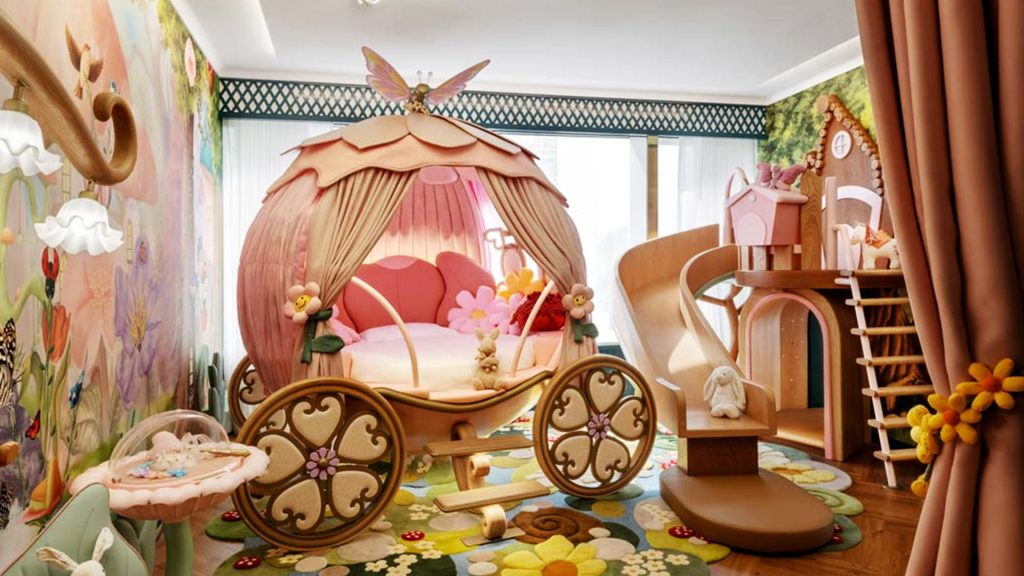
Practical Suggestions for Equipment Suppliers:
1. Diagnose the flow of movement in playroom layout before choosing equipment: Help owners analyze the entire process of “family from getting out of the car to checking in,” identify experience gaps (such as children crying while waiting at the front desk), and prioritize using equipment to fill these “emotional respite points.”
2. Emphasize “safety equals aesthetics”: Use soft-touch corkboard, rounded corners, and environmentally friendly materials (such as corkboard, walnut wood, and green upholstery). These are both selling points and reassurances for parents.
3. Sell “time spent together,” not just “equipment”: Emphasizing how the space allows parents to relax, children to explore, and families to connect emotionally is more persuasive than simply listing product parameters.
The children’s spaces in hotels of the future will no longer be cold, impersonal installations, but warm, story-filled, and nurturing third spaces for families. By focusing on the three key concepts of “vertical utilization,” “narrative immersion,” and “integration of large and small spaces,” we will offer more than just equipment; we will provide a comprehensive family playroom solution that helps hotels increase average revenue per customer and repeat purchase rates.